Company News
You Can't Scale What You Can't Explain
A conversation for finance, RevOps, and systems leaders on quote-to-cash transformation, cross-functional operations, and getting aligned before you scale.
Read post →Guides, case studies, and practical knowledge for revenue operations, finance, and engineering teams running Salesforce and NetSuite.
Practical thinking on quote-to-cash, revenue operations, and the Salesforce–NetSuite ecosystem.
A conversation for finance, RevOps, and systems leaders on quote-to-cash transformation, cross-functional operations, and getting aligned before you scale.
Read post →
For SaaS leaders running Salesforce and NetSuite — especially CFOs, RevOps, and technical owners dealing with recurring integration failures at month-end.
Read post →
For CFOs, RevOps leads, and anyone who has watched Finance absorb the consequences of commercial decisions made without them in the room.
Read post →
For SaaS leaders running Salesforce and NetSuite — why consolidating your entire revenue stack into one tool creates more problems than it solves.
Read post →
For Salesforce CPQ users, RevOps leaders, IT teams, and finance stakeholders at SaaS companies planning or evaluating the move to ARM.
Read post →
How ramps, swaps and RPO are quietly distorting the revenue picture at your SaaS investments — and what it takes to fix it.
Read post →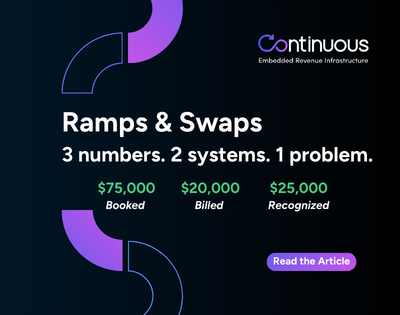
Why the math is easy, the execution isn't, and both are costing SaaS companies more than they realize. For CFOs, CROs, and RevOps leaders.
Read post →
The industry's first certified product that seamlessly aligns CRM to ERP for complex hybrid subscription and advanced consumption revenue models.
Read post →
A practical guide for revenue, finance, and product teams on how product usage data becomes contract-governed consumption and recognized revenue.
Read post →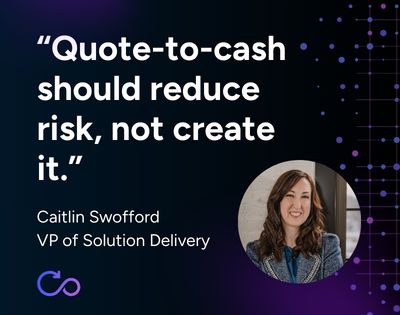
A Q&A for finance and RevOps leaders on delivery, embedded revenue infrastructure, and how to fix quote-to-cash in NetSuite without adding risk.
Read post →
A Q&A for product, delivery, and operations leaders on how Continuous builds operating discipline, predictable delivery, and scalable execution.
Read post →
A recap for RevOps, Sales Ops, Finance, and Product leaders on CPQ end of sale, ARM readiness, and how to plan next steps.
Read post →Downloadable case studies with the metrics, methods, and outcomes from enterprise teams that implemented Continuous. For the full story behind each customer, visit Customer Stories.

ACI Learning runs enterprise IT training on a subscription model with complex entitlements. Order data lived in Salesforce. Revenue recognition lived in NetSuite ARM. A manual sync process was creating errors and delaying close.
"Continuous gave us the connective tissue between Salesforce and NetSuite that we were missing. The manual work is gone, and so is the stress at month-end close."

Avalara's usage-based licensing model required real-time metering data to flow from their consumption infrastructure through Salesforce into NetSuite ARM for revenue recognition. Their existing approach required costly custom development to maintain.
"We needed something that could handle our usage model natively, not another middleware layer we'd have to maintain. Continuous fit exactly into how we run Salesforce and NetSuite."

Aurora Solar's solar design and sales software includes both subscription and usage pricing components that needed to flow cleanly through Salesforce CPQ into NetSuite ARM for revenue recognition, without custom code or manual reconciliation.
Download case study →
Medallia's enterprise experience management platform involves complex multi-year deals and usage-based components that needed to synchronize accurately between Salesforce and NetSuite ARM at scale.
Download case study →
Dwolla's consumption-based pricing model required usage events to be rated, mediated, and matched to subscription commitments before flowing into billing in NetSuite, with no custom development.
Download case study →A real estate technology SaaS company managing property intelligence subscriptions with complex billing schedules that needed to map cleanly to NetSuite ARM revenue recognition, without manual workarounds.
Download case study →Continuous is independently audited and certified for both SOC 1 Type 2 and SOC 2 Type 2. We meet the control requirements of both your finance and security teams.
View Trust Center →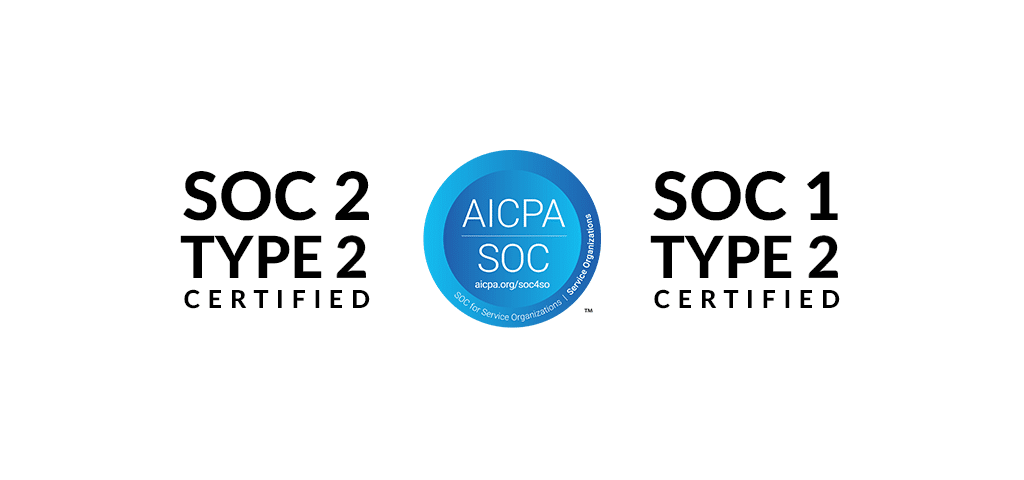
Security, availability, processing integrity, confidentiality, and privacy controls. Audited over a sustained observation period.
Financial reporting controls over the systems that touch your revenue data. Critical for companies using Continuous to connect Salesforce and NetSuite ARM.
Listed on Salesforce AppExchange and the NetSuite SuiteApp Marketplace. Vetted, reviewed, and approved by both platform security teams.
Our Trust Center includes real-time security posture, uptime history, subprocessor list, and access to our compliance documentation. No NDA required to view.
View Trust Center ↗Key terms for revenue operations, finance, and engineering teams in the Salesforce–NetSuite ecosystem.
Deployment guides, API references, configuration walkthroughs, glossary, and more. For admins, architects, and developers building on Continuous.
The questions we hear most from RevOps, Finance, and Engineering teams evaluating Continuous.
Salesforce and NetSuite. We know them both. Let's talk about your quote-to-cash setup.